Video Marketing
Product & Demo Videos
Explainer Videos
Conversion & SaaS Growth
Dixie
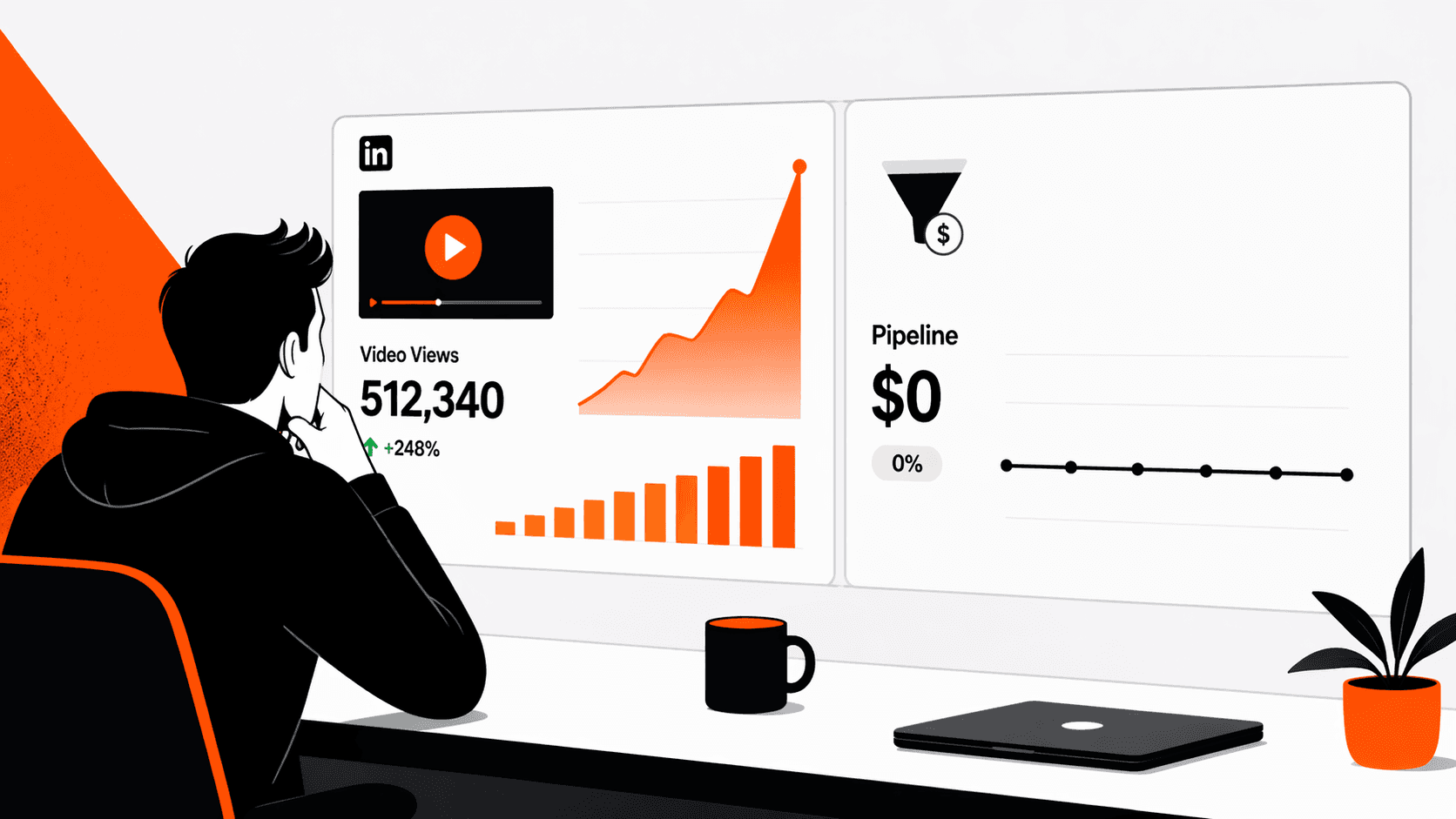

Vanity metrics are the silent killers of SaaS marketing budgets. Your agency sent you a deck last week. "10,000 video views. 4.2% engagement rate. CTR up 18% month-over-month." You nodded along and then opened your CRM. Zero new qualified demos. Pipeline unchanged. CAC climbing.
Here's the thing nobody in the agency world will say out loud: your LinkedIn video ad was built to win awards, not to win deals. And in B2B SaaS, those are two completely different briefs.
The numbers that should stop you scrolling

Before we talk strategy, here's the data that exposes the problem:
Video ads have the lowest CTR of any LinkedIn ad format averaging just 0.44%, below single-image (0.56%) and carousel (0.40% combined average), according to ZenABM's 2026 analysis of 211 B2B companies and $5.5M in ad spend.
High CTR actively correlates with lower pipeline quality ZenABM's report found that "high engagement formats like video don't always drive pipeline," and that higher CTR can reflect broad, unqualified targeting.
85% of LinkedIn video views happen with sound off (Digiday) meaning your perfectly scored voiceover, your cinematic reveal, your brand-voice narration? Muted. Every time.
This is the gap no agency is talking about. Views are cheap to report. Pipeline is painful to explain. So most agencies optimise for the former and hope you don't notice the latter.
Why high production value is costing you pipeline
The most counterintuitive truth in B2B video advertising: the more polished your video, the less it probably converts.
Here's why. A high-production SaaS video is designed to impress. It has sweeping transitions, a professional voiceover, a cinematic opening shot, and a tagline that took three rounds of stakeholder reviews. What it doesn't have is a reason for your ICP a VP of Operations at a Series B company to stop scrolling in the first three seconds and think, "That's exactly my problem."
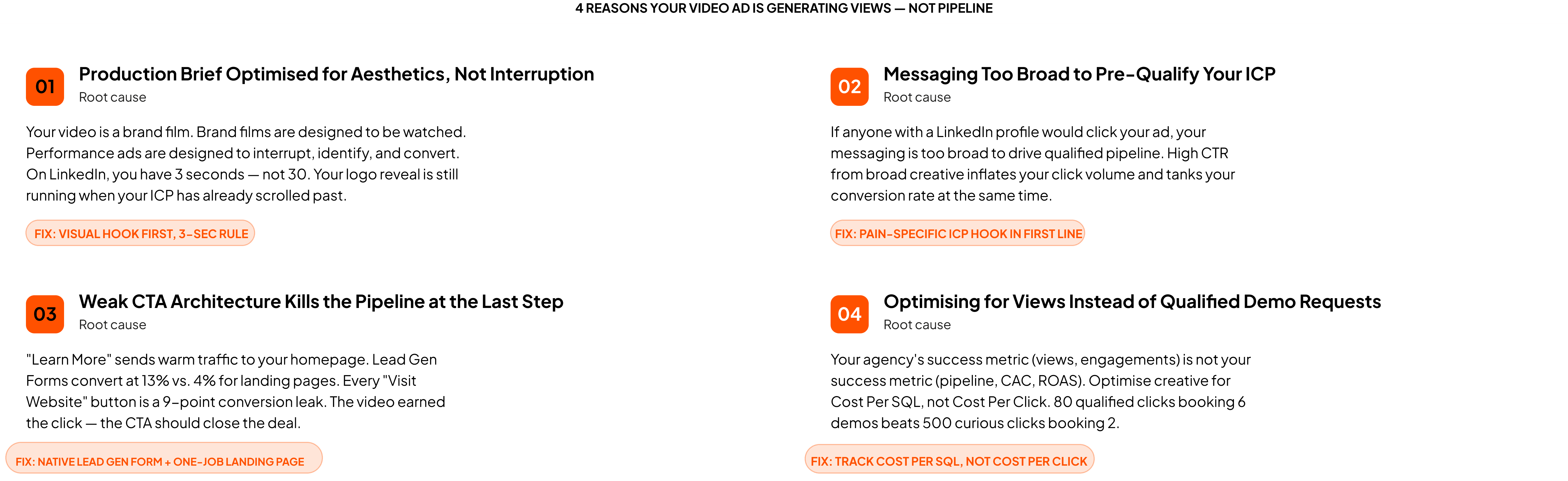
LinkedIn is a professional feed, not a streaming platform. Your buyer is skimming between a Gartner report and a recruitment post when your ad appears. You have three seconds. Not thirty. Three. And in those three seconds, your beautifully animated opener is still running through its logo reveal while your buyer has already scrolled past.
The structural error is that most SaaS video ads are built like brand films. A brand film is designed to be watched. A performance ad is designed to interrupt, identify, and convert — in that order. These are fundamentally different creative briefs. When you give a video production company a "make us look premium" brief, they build a brand film. When you brief Explainerz to build a performance ad, we start with the hook, the pain point, and the CTA and build backwards from there.
The Explainerz Fix: Every video ad we build starts with a three-second visual hook that works completely without sound. We use bold text overlays, on-screen problem statements, and kinetic graphics that communicate the core pain point before a single word of voiceover is heard. Sound off = no problem. The message lands either way.
The leading cause of zero-pipeline video ads is a production brief optimised for aesthetics over interruption fix the brief before you fix the budget.
What your agency is tracking vs. what actually builds pipeline
Here's the metrics translation table that nobody gives SaaS founders:
What your agency reports → What it actually means:
Views → Someone's feed auto-played your video for 2 seconds
Engagement rate → Someone clicked "see more" on the caption
Video completion rate → They watched to the end. Then left.
CTR → They clicked. They weren't qualified. Your CPC just climbed.
HockeyStack's benchmark report built on data from 70+ SaaS companies, $28M in LinkedIn ad spend is blunt: "CTR and CPC don't tell the full story. Measuring in-platform metrics alongside precisely defined funnel outcomes will help marketers determine how LinkedIn Ad campaigns are progressing leads through the sales cycle."
The outcome you want is not a click. It's a qualified demo request. That means your video needs to pre-qualify the viewer before they click. A video that attracts 500 curious clicks and books 2 demos has a worse CAC than a video that attracts 80 qualified clicks and books 6 demos. Broad creative drives broad traffic. Specific creative drives pipeline.
The fix is not a new targeting layer or a higher budget. The fix is writing your video ad like a qualifier, not a brochure. Your hook should name the pain point so specifically that unqualified viewers self-select out. Your CTA should ask for a decision, not a browse.
The Explainerz Fix: We build SaaS video ads around a three-part pipeline framework: Hook (name the exact pain), Problem (prove you understand the cost of inaction), CTA (make the next step frictionless and specific). Every element is built native to the platform no repurposed explainer videos, no brand reels. Pipeline-first creative from brief to delivery.
Your LinkedIn ad creative should pre-qualify your ICP before they click if anyone with a LinkedIn profile would click your ad, your messaging is too broad to drive qualified pipeline.
The CTA is where pipeline actually dies
You got the hook right. Your viewer watched 80% of the video. They're interested. And then you ask them to "Learn More."
Learn more what? Learn more how? On a landing page that looks like it was designed in 2019, with a hero section that says "The Future of Work" and a form with eight fields?
This is where the money dies. And it's almost never the video's fault at this point it's the CTA architecture. On LinkedIn, you have two choices that actually convert: Lead Gen Forms (which keep the user on-platform and pre-fill their details) or a landing page with one job to do. Not your homepage. Not your features page. A dedicated, friction-zero page that says: "Here's what you just watched. Here's the next 15-minute call that makes it real. Book it."
LinkedIn's own data confirms this: Lead Gen Forms convert at 13% versus 4.02% for external landing pages. That is a 3x conversion lift from not making your viewer leave LinkedIn. Yet most SaaS video ad campaigns still end with a "Visit our website" button sending cold traffic to a homepage carousel.
The video and the CTA are one system. A great video feeding into a weak CTA is like driving a Formula 1 car into a car park: all that speed, nowhere to go.
The Explainerz Fix: When we build your ad video, we architect the CTA into the script not as an afterthought. We build native-platform endings: Lead Gen Form copy, landing page messaging brief, and in-video on-screen CTA overlays. The video earns the click. The CTA closes the gap. You can explore our SaaS Explainer Video and Product Demo Video approaches to see how we integrate this end-to-end.
The CTA is not a button it is the last line of your video ad script, and it determines whether a view becomes a pipeline entry or just another impression.
The ROI math your agency isn't running
Let's close the loop on what this actually costs you.
SaaS companies on LinkedIn average $6.50 CPC and a CPA of $150–$400 per lead (SaaS Hero, 2026). If your video ad is pulling unqualified clicks at $6.50 CPC, and only 2% of those clicks become pipeline-ready leads, you're spending $325 per lead before qualification. Post-qualification — after your SDR team has worked through the junk — your actual Cost Per Qualified Lead is likely $600–$1,200.
Now run that against a video ad built around a pipeline-first brief: same CPC, but your specific hook pre-qualifies the viewer, your CTA routes them directly to a Lead Gen Form, and your landing page does one job. Conversion rate doubles. Qualified lead volume stays the same. Your CAC drops by 40–50% — not because you spent more, but because the creative is doing more of the qualification work.
This is what Explainerz means when we say video is a revenue asset, not a content line item. A SaaS Explainer Video or performance ad built on the right brief isn't an expense. It's a CAC reduction mechanism. And unlike your SaaS subscription stack, it works every time someone sees it indefinitely.
The math is simple: better creative brief → higher ICP relevance → lower junk click rate → lower CAC → higher ROAS. The platform doesn't change. The targeting doesn't change. The creative does.
The Explainerz Fix: We audit your current video ad creative against the pipeline-first framework — hook relevance, ICP specificity, CTA architecture, and landing page alignment — and rebuild from the structural gap up. The starting point is our Animated Explainers Plan at $2,500 one-time, which delivers a 60–90 second performance-engineered ad video in 2–3 weeks. No guesswork. No vanity metrics. Just pipeline.
When video creative is engineered to pre-qualify rather than impress, CAC decreases without touching ad spend the brief is the lever, not the budget.
Ready to stop paying for views and start booking demos?
Your LinkedIn video ad should be the most efficient member of your sales team qualifying leads at scale, 24 hours a day, before a single SDR sends a follow-up. Right now, it's probably your most expensive brand awareness piece dressed up as a performance campaign.
That gap closes with the right brief.
Book a free strategy call → explainerz.com/contact
Or explore our work at explainerz.com/work and see what pipeline-first video looks like in practice.



