Video Marketing
Product & Demo Videos
Explainer Videos
Conversion & SaaS Growth
Dixie
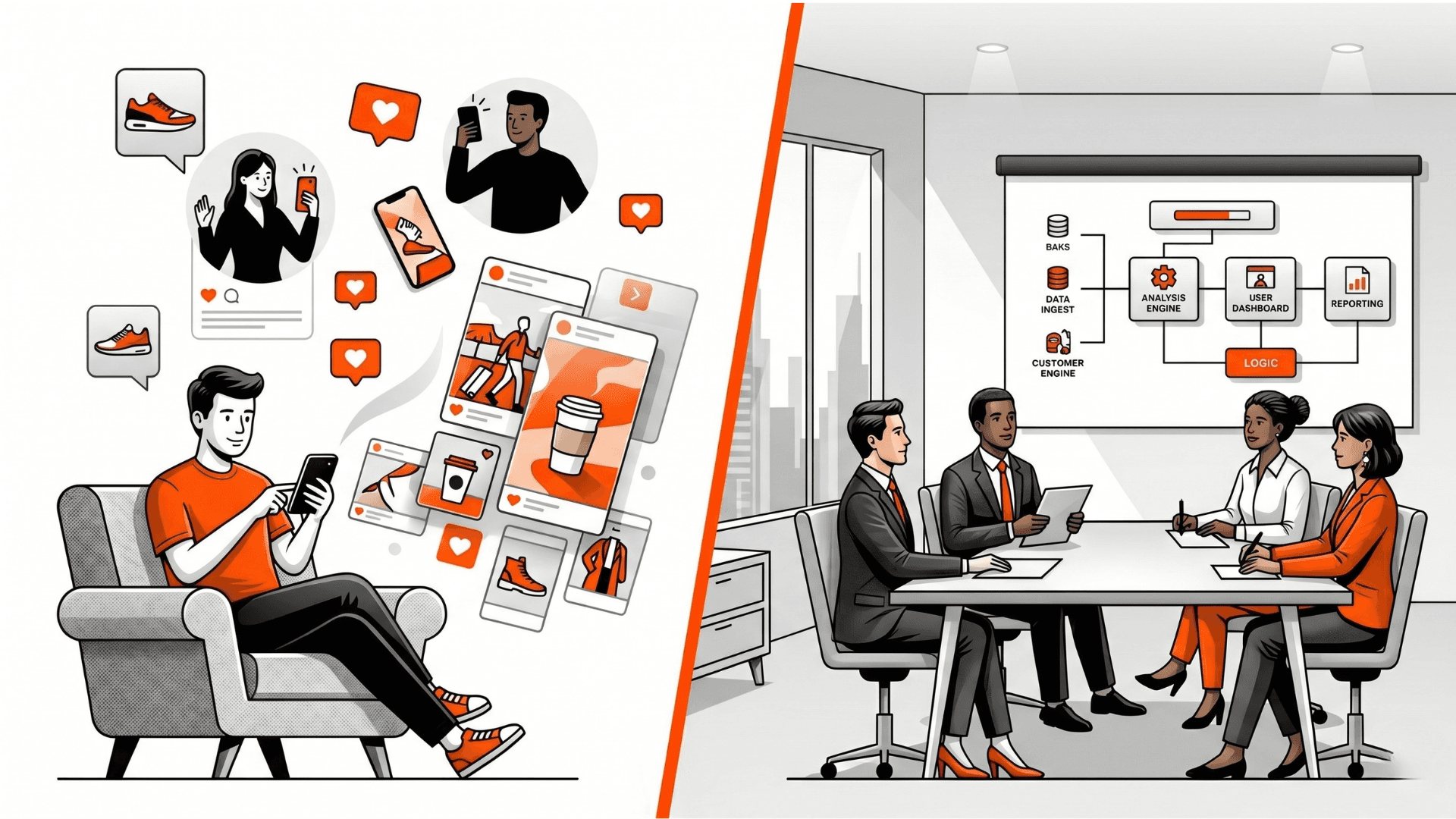
Entertaining a B2B buyer is great. But if they don't know how your software integrates with Salesforce after 60 seconds, you just wasted their time — and probably stalled a five-figure deal.
Here's the problem nobody in the video marketing space wants to say out loud: most SaaS marketing teams are producing B2C content for B2B buyers. They're lifting TikTok pacing, Instagram aesthetic, and consumer emotional hooks then dropping them into enterprise software marketing where they don't belong.
The result? Videos that win applause in the marketing team's Slack channel and generate zero pipeline momentum.
The numbers that should stop you cold
73% of B2B buyers say video is their preferred way to learn about a product or service. That's not a reason to celebrate your current video strategy, it's pressure to get it right.
The average B2B buying committee now has 11 stakeholders (Gartner, 2025), up nearly 100% from a decade ago. For enterprise technology purchases, that number can climb to 25. IT, finance, legal, procurement, and multiple business unit leads are all in the room when a decision gets made.
92% of B2B buying decisions are made by groups of two or more people (Forrester). Not one impressed executive. Not one scroll-stopping moment. A coalition of stakeholders who each have different concerns, different questions, and a different reason to say no.
A 30-second emotion reel cannot serve 11 decision-makers. A fast-cut montage does not answer the security engineer's integration question. A lifestyle aesthetic does not give the CFO the ROI case she needs to approve the spend.
Every B2B SaaS video must be engineered for consensus-building not individual impulse.
Why B2C formulas break in B2B buying cycles
The structural difference between B2C and B2B video is not about production quality or even tone. It's about who is watching, what they need, and what happens after they stop watching.
In B2C, a single buyer sees the ad, feels something, and clicks. The entire purchase process can happen in minutes. Emotion is the engine. Aesthetic is the accelerant. Entertainment is the conversion mechanism.

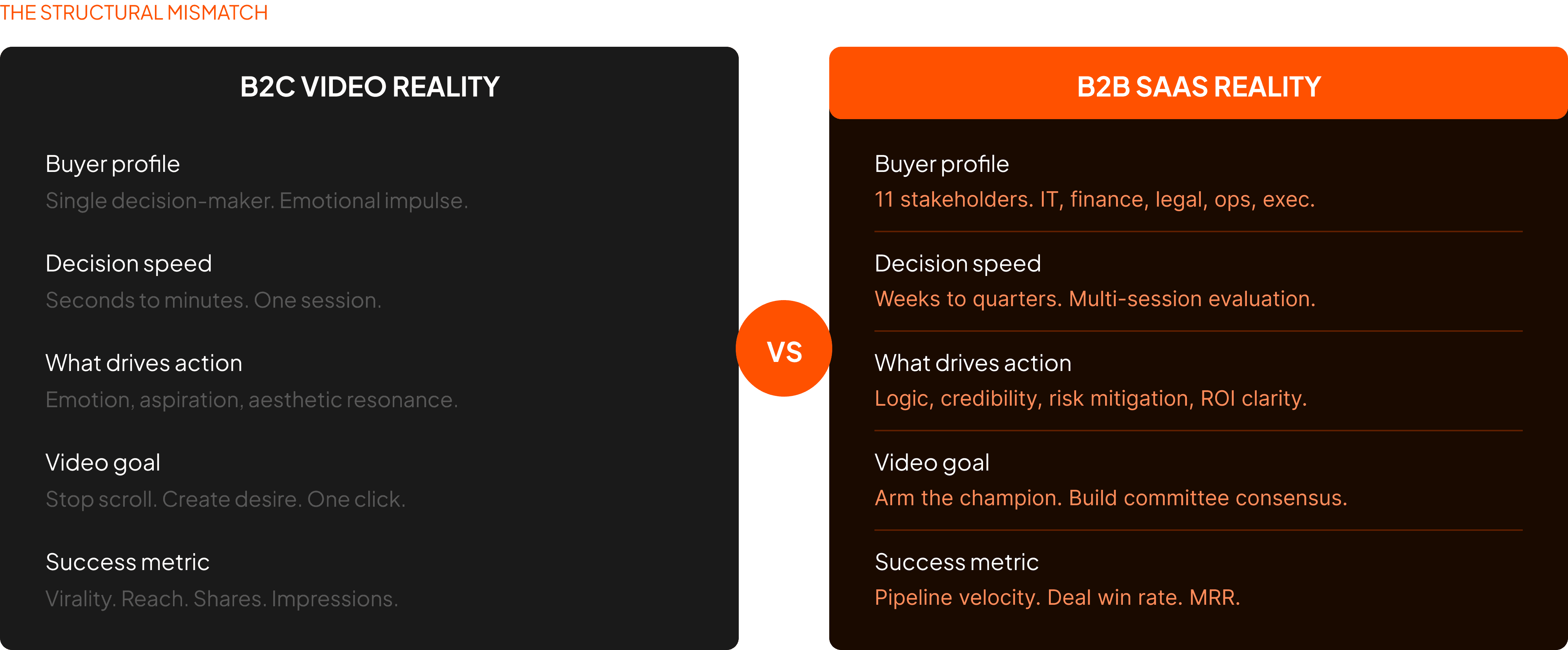
In B2B SaaS, your video gets forwarded in a Slack thread to a VP who has 11 minutes between calls. That VP shares it with the CTO, who shares it with the security team. Each person is evaluating a different dimension of your product and they're doing it without you in the room.
That means your video has to do something B2C ads never need to do: speak to multiple stakeholders simultaneously, answer technical and commercial questions, and make your champion look smart for recommending you.
A cinematic brand film fails this test. An influencer-style "day in the life" fails this test. A 30-second vibe reel fails this test spectacularly.
The Explainerz Fix: A SaaS Explainer Video built for B2B must open with the precise pain, demonstrate the mechanism of the solution, address integration and risk signals that surface in committee review, and close with a next step calibrated to buyer readiness — not a hard consumer-style CTA. That's not a creative opinion. That's what closes enterprise deals.
B2C video sells to a moment. B2B video must survive a committee.
The four B2C mistakes killing your B2B pipeline
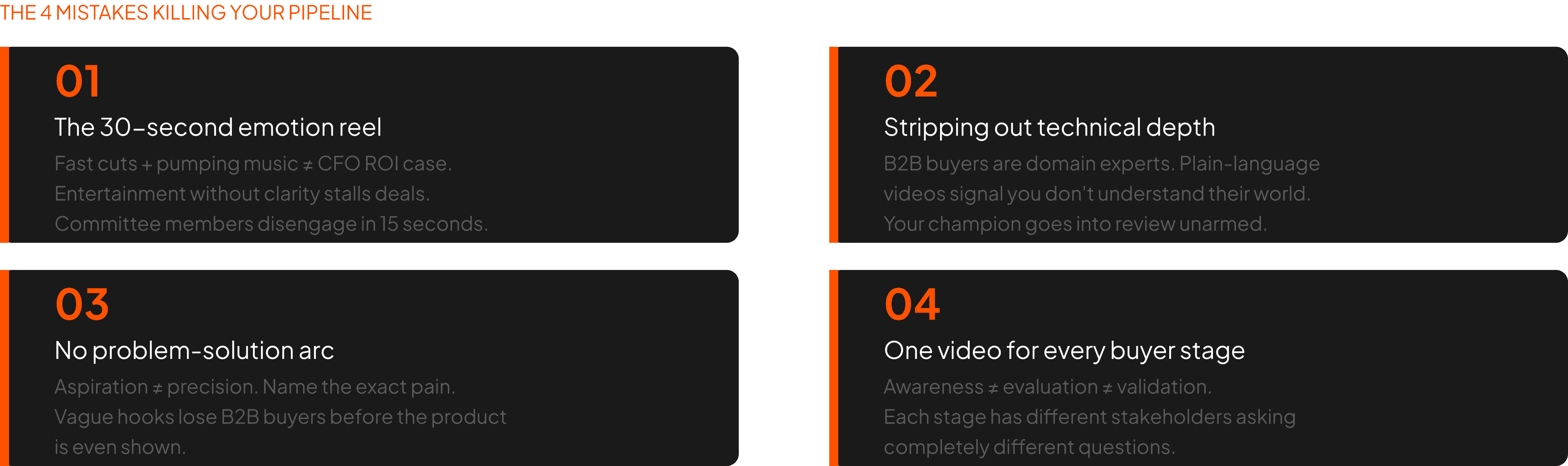
Mistake 1: The 30-second emotion reel. Fast cuts, pumping music, smiling people on MacBooks. This performs on awareness metrics and generates zero qualified pipeline. When a security engineer is evaluating your data residency model, "inspiring" is not the job to be done.
Mistake 2: Stripping out technical depth. B2C brands speak in plain language because their audience is general. B2B buyers are domain experts. Removing technical specificity to "keep it accessible" signals that you don't understand their world — and leaves your champion with nothing to defend internally. Your video is going into a buying committee meeting without you. It needs to make the case on your behalf.
Mistake 3: No problem-solution arc. Consumer ads can lead with aspiration. B2B buyers need to see their exact problem reflected before they invest attention. If your video doesn't name the pain precisely — not "collaboration challenges" but "your engineering team is shipping broken releases because QA and dev are working from different source-of-truth" — skeptical stakeholders disengage before you ever show the product.
Mistake 4: One video for every stage. B2C brands run one hero spot. B2B deals move through distinct stages — awareness, evaluation, validation, procurement — each with different viewers and different questions. A single video trying to do everything answers nothing well. The VP of Engineering evaluating integrations needs different content than the CFO calculating ROI.
The Explainerz Fix: Our SaaS Product Demo Videos are built around stage-specific viewer intent. We map the buying committee, identify the questions each stakeholder is asking at each stage, and structure video content that moves every person in the room from skeptic to advocate. See our work to understand what committee-ready video actually looks like.
The SaaS founders winning enterprise deals in 2026 have one video asset for each stage of their buying committee — not one brand film for everyone.
What committee-ready video actually looks like
The buying committee is not a problem to be solved with more video. It's a structural reality that your video strategy must be built around from day one.
Committee-ready B2B SaaS video has three properties that B2C video never needs:
It speaks two languages simultaneously. Executive language: growth, ROI, competitive advantage. Technical language: API, implementation, security model, integrations. A video that only speaks one loses half the committee before the product is even shown. A video that balances both gives your champion a single asset they can share across the room.
It arms the champion. In B2B, your actual customer is often not the final decision-maker. They are the internal advocate who needs to convince their CFO, their CTO, and their legal team. Your video is their ammunition. If it doesn't answer the questions those stakeholders will ask, your champion goes into that meeting unarmed — and your deal stalls.
It earns trust through demonstrated competence, not manufactured energy. B2B buyers don't need to be entertained into trust. They need to see that you understand their specific problem better than anyone else. When your video opens with their exact pain, explains the mechanism of your solution with precision, and shows a credible path from problem to outcome — that's the moment a B2B buyer stops evaluating and starts advocating.
The Explainerz Fix: Explainerz balances engaging pacing with clear, logical problem-solution frameworks built for consensus buying. Our 10-year track record with 150+ explainers delivered to companies like Kodecloud, Sencha, and McGraw Hill means we've learned exactly what makes a buying committee move from "interesting" to "approved." Ready to build video that closes enterprise deals? Contact us.
Committee-ready video doesn't just look good — it answers the questions that kill deals in internal review.
The brand authority dividend nobody talks about

There's a compounding return to getting B2B SaaS video strategy right that goes beyond any single deal.
When your video content consistently demonstrates domain depth, technical credibility, and buyer-centric thinking, it reshapes how the market perceives your category authority. Buyers share it internally not because it went viral, but because it was genuinely useful to a buying committee trying to make a hard decision. That kind of organic distribution is worth more than any paid campaign, because it reaches the stakeholders you'd never target directly.
The data confirms it: 65% of executives visit a vendor website after viewing their video, and 39% contact the vendor directly. That behaviour doesn't happen because of a cool edit. It happens because the video made them feel understood and gave them a reason to take the next step.
The SaaS teams most tempted by B2C aesthetics are often the ones closest to having something genuinely worth explaining. The product is real. The pain point is acute. The differentiation exists. All that's missing is a video strategy that trusts the intelligence of the B2B buyer and gives them what they actually need to say yes.
You're not selling sneakers. Stop making sneaker ads.
The Explainerz Fix: If your current video strategy is built around B2C formats, we can help you rebuild it for the buying committee reality of enterprise SaaS in 2026. Start with a free strategy call. Contact Explainerz →
B2B video authority is built one committee-ready asset at a time — and it compounds into category leadership.
Explainerz is a SaaS Explainer & Demo Video Agency trusted by 100+ companies. 150+ explainers delivered. 10 years in the industry. explainerz.com



