Video Marketing
Product & Demo Videos
Explainer Videos
Conversion & SaaS Growth
Dixie
The Interactive Demo Trap: Why Navattic and Demostack Won't Replace Your Explainer Video
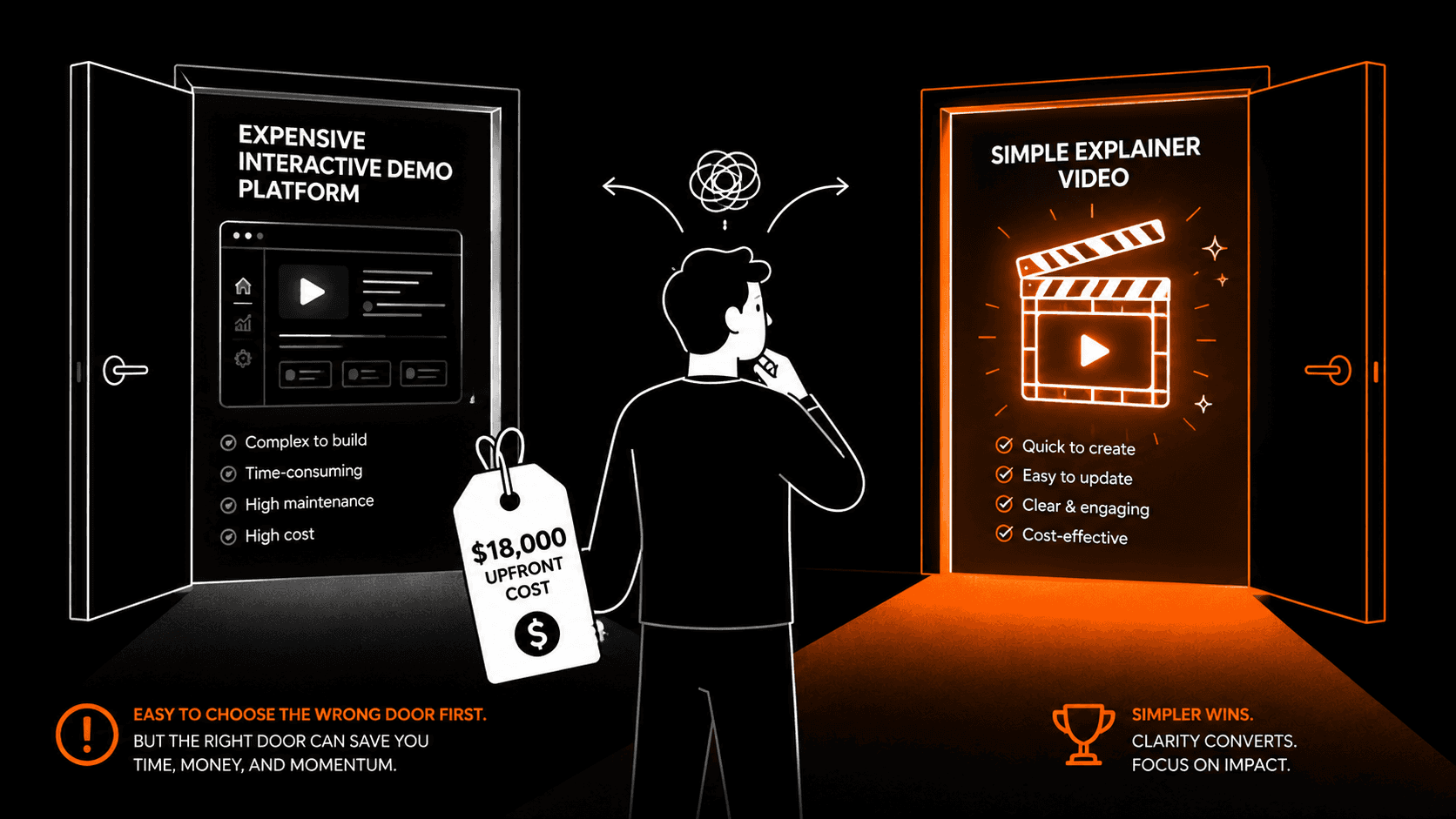
I had a founder message me last month. Spent $18,000 on Navattic. Beautifully built interactive product tour. Prospect analytics wired up. The whole setup.
Bounce rate on his homepage: 74%.
Demo bookings: flat.
He asked me if his interactive demo was broken. It wasn't. The interactive demo was working exactly as designed. The problem was that he'd bought a checkout counter and skipped building the store.
That's the Interactive Demo Trap. And right now, thousands of SaaS founders are walking straight into it.
Why did everyone suddenly need an interactive product tour?
The stat is real and compelling: 7 in 10 B2B buyers complete most of their product evaluation before they ever contact a vendor. So the logic follows let them explore your product before they talk to sales. Give them a self-guided tour. Remove friction. Ungated demos, higher intent, faster closes.
And interactive demo platforms ran with that insight. Navattic built over 40,000 demos in 2025, a 35% jump year-over-year. The category is exploding. Eighteen percent of B2B SaaS websites now feature an interactive demo CTA up 40% from the prior year.
But here's what no one selling you a $12,000-per-year demo platform is going to tell you: an interactive demo only works on a prospect who already believes they have the problem you solve, already understands your product category, and has already decided they want to evaluate you specifically.
That is not a top-of-funnel visitor. That is a highly qualified, mid-funnel buyer.
If you build an interactive demo before building belief, you're handing a product manual to someone who hasn't decided they need the product.
The Explainerz Fix: Before your interactive demo can do its job, a prospect needs to believe your product solves their problem. A 60–90 second animated explainer from explainerz.com creates that belief in the time it takes to scroll past your hero section then your Navattic tour has an audience actually ready to use it.
What interactive demos are actually built for
Let me be precise here, because the nuance matters for your budget.
Navattic, Demostack, Storylane, Arcade these are mid-to-bottom-funnel evaluation tools. They shine when a prospect already knows they need a solution like yours, has narrowed their shortlist, and wants to poke around before booking a call with your sales team. That's a legitimate and valuable use case. I'm not here to tell you interactive demos are useless.
What I am telling you: they cannot create awareness. They cannot build category demand. They cannot carry a cold traffic visitor from "I have a vague sense something's wrong in my ops stack" all the way to "I need to click through this product tour."
There's a reason the interactive demo category exploded in sales-led, enterprise SaaS companies with existing brand awareness, inbound pipelines, and SDRs warming leads before prospects ever hit the product tour. In that context, an interactive demo is a phenomenal sales tool.
For a $2M ARR founder trying to convert cold traffic into trial signups, it's a $15,000 mistake.
Interactive demos assume the work of awareness has already been done they are a tool for evaluation, not education.
The Explainerz Fix: If your product is genuinely complex or your category is still being defined, pair your interactive demo with an animated SaaS explainer video. See how Explainerz structures exactly this dual-asset approach at SaaS-Demo-Video page.
Do I need an interactive demo or an explainer video for my SaaS?
Here's the question I get asked most often, and here's the honest answer: you probably need both. But you need to build them in the right order, and understand what job each one is hired to do.
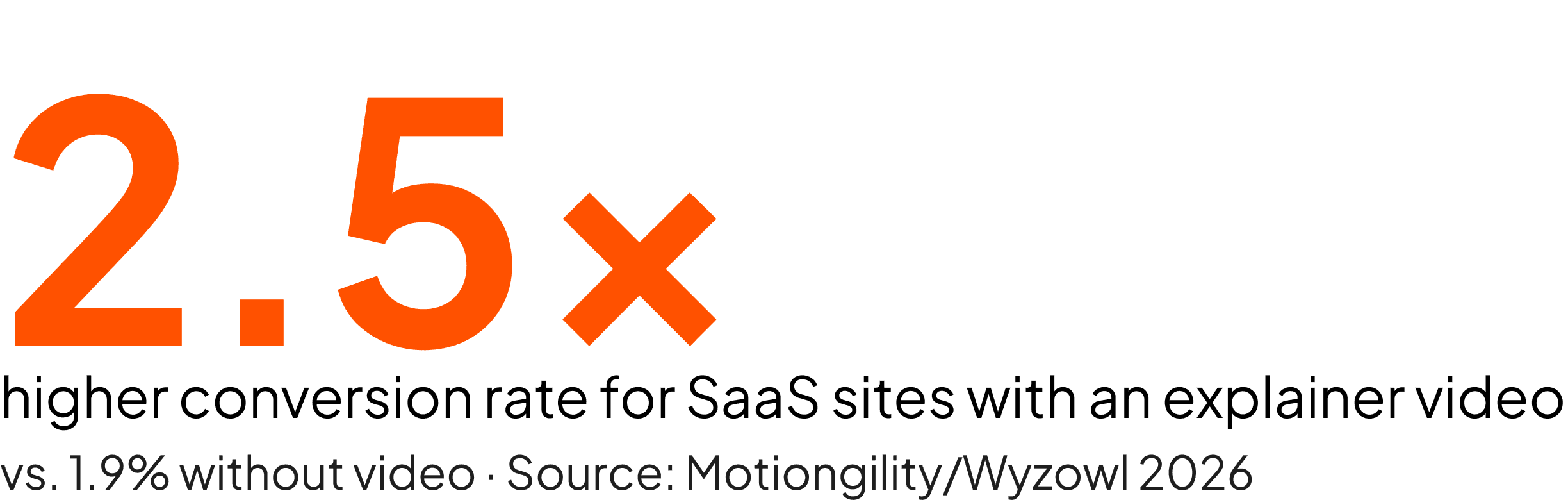
Think of your funnel as a two-act play. Act One is belief creation. A visitor lands on your site paid ad, organic search, LinkedIn post, whatever. They don't know if they have the problem you solve. They definitely don't know if your product is the solution. The job of Act One is to make them care enough to stay. That's the explainer video's domain. Sixty to ninety seconds of sharp, problem-first storytelling that transforms a stranger's vague frustration into a felt need. SaaS sites with explainer videos convert at 4.8% versus 1.9% without a 2.5× lift, and that's on cold traffic.
Act Two is evaluation. The prospect now believes they have the problem. They believe a product like yours might solve it. Now they want proof. They want to click around, see if the UI makes sense, understand the workflow. This is where your Navattic tour earns its keep.
Run Act Two before Act One and you get exactly what that founder experienced: a beautiful interactive demo with analytics showing that most people click exactly one step before leaving.
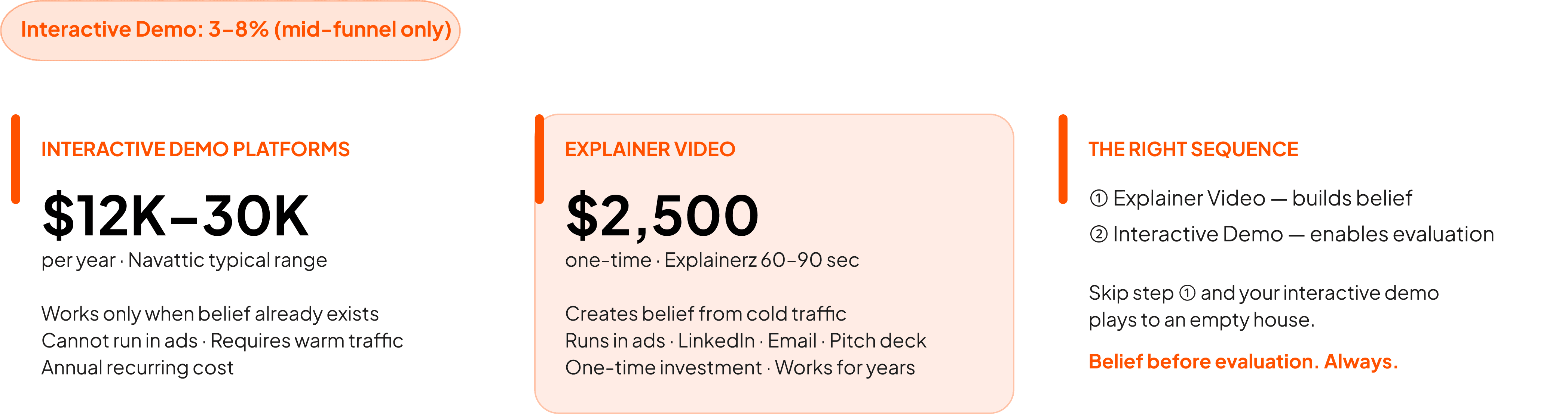
The explainer video performs Act One so the interactive demo can perform Act Two skip the first act and your tour plays to an empty house.
The Explainerz Fix: Need both assets but not sure where to start? Every Explainerz engagement begins with the script the belief-building narrative that has to work before anything else does. Start at explainerz.com.
The Navattic vs explainer video budget conversation no one's having
Navattic's pricing typically runs $12,000–$30,000 per year depending on your tier. Demostack can run significantly more for enterprise teams. These are recurring costs you pay them every year.
A professional animated SaaS explainer video from a specialist agency costs $2,500–$10,000. One time. It lives on your homepage, your paid ad campaigns, your LinkedIn, your sales emails, your pitch deck, and your onboarding sequence for years.
I'm not saying Navattic isn't worth it for the right company at the right stage. I'm saying that if you're deploying $15,000 into an interactive product tour and your homepage video is still a screen recording your engineer did on Loom, you have the funnel backwards.
The explainer video is load-bearing infrastructure. The interactive demo is a feature built on top of it. You don't build features on infrastructure you haven't laid yet.
There's a useful post from the Explainerz team on this exact sequencing question the Explainerz blog walks through how SaaS companies at different ARR stages should think about their video stack.
Spend $2,500 on the belief engine before you spend $18,000 on the evaluation engine — in that order, the ROI compounds; in reverse, neither works.
The Explainerz Fix: A 60–90 second Explainerz animated explainer ships in 2–3 weeks, includes scripting, storyboarding, animation, voiceover, and 3 revisions at $2,500. That's the belief engine. Build it first. See the portfolio at work page.
Why generalist interactive demo tools fail SaaS storytelling
There's a subtler problem with leaning on interactive demos as your primary conversion asset, and it's a brand problem.
An interactive demo shows your product. It does not tell your story. And in a category where five competitors have similar feature sets, the story is the differentiator.
Animated explainer videos give you something interactive demo platforms literally cannot: creative control over the narrative. You're not constrained by your product's current UI. You can show the before the chaos, the inefficiency, the embarrassing spreadsheet and then reveal your product as the elegant answer. You can use metaphor, motion, pacing, voiceover tone, and character to create emotional resonance that a click-through product tour never will.
The explainer video is also inherently shareable. You can run it in a LinkedIn ad. You can embed it in a cold outreach email. You can put it in a pitch deck. An interactive demo is a destination prospects have to navigate to it. An explainer video is a missile it goes wherever your audience is.
Your story needs to travel to where your prospects live; interactive demos require prospects to travel to where your story lives.
The Explainerz Fix: Clients like Kodecloud, Sencha, and McGraw Hill trusted Explainerz to own the storytelling layer. View what SaaS-specialist video storytelling actually looks like at our work page.
The explainer video vs product tour SaaS decision framework
Here's a simple test I give founders who ask which they should build first.
Can a stranger landing on your homepage from a cold paid ad answer these three questions in 90 seconds or less: What is the specific problem your product solves? Who specifically has that problem? Why is your solution meaningfully different from the alternatives?
If the answer to any of those is no and for most SaaS companies it is you need an explainer video before anything else. The interactive demo serves prospects who can already answer all three. The explainer video is what teaches them the answers.
Run this on your own homepage right now. Pull up your site as if you'd never heard of your company. Give yourself 90 seconds. If you can answer all three questions clearly and compellingly, you have a belief-creation asset in place. If you can't, you have a gap that no amount of interactive product tour sophistication will fix.
The 90-second stranger test tells you whether you're ready for an interactive demo or still need an explainer video and most SaaS founders fail it.
The Explainerz Fix: Explainerz specializes in answering these three questions in 60–90 seconds flat, for SaaS products of any complexity. Contact the team directly at contact page.
Interactive product demo tool alternatives that don't cost $18K a year
I want to be useful here, not just critical. If you're earlier-stage and the enterprise Navattic pricing doesn't make sense, there are interactive demo platforms worth evaluating: Arcade for fast, embedded product snippets; Storylane for HTML-capture demos at more accessible pricing; Supademo for teams that need unlimited demos on a tighter budget.
But my actual recommendation is this: spend your first content dollar on the explainer video. Get the belief engine working. Then add an interactive demo layer once you have proof that qualified traffic is landing and staying. The interactive demo tool category is not going anywhere you can add it at Series A. The cost of not having an explainer video at seed stage is paid in conversion rates you'll never recover.
The best interactive demo tool alternative is the asset that makes your interactive demo work a sharp, problem-first explainer video that converts strangers into prospects.
The Explainerz Fix: Ready to build the belief engine first? The Explainerz team can turn your core value proposition into a 60–90 second animated explainer in 2–3 weeks. Reach out at Sales@explainerz.com.
The decision you're actually making

When you choose between an interactive demo platform and an explainer video, you're not choosing between two content formats. You're choosing which part of the funnel to invest in first.
Interactive demo platforms bet that your audience already understands your category and your value. Explainer videos create that understanding. One of those bets is safe regardless of your stage. The other requires significant prior work to pay off.
The founders who get this right aren't choosing between the two they're sequencing them properly. Explainer video first, interactive demo second. Belief before evaluation. Story before tour.
If your homepage still doesn't answer the 90-second stranger test, the Navattic renewal can wait. The explainer video cannot.
Ready to build the asset your interactive demo actually needs to succeed? Reach out to the Explainerz team or email Sales@explainerz.com directly. We deliver in 2–3 weeks, and we've done this for 150+ SaaS products. The first conversation is free.


