Video Marketing
Product & Demo Videos
Explainer Videos
Conversion & SaaS Growth
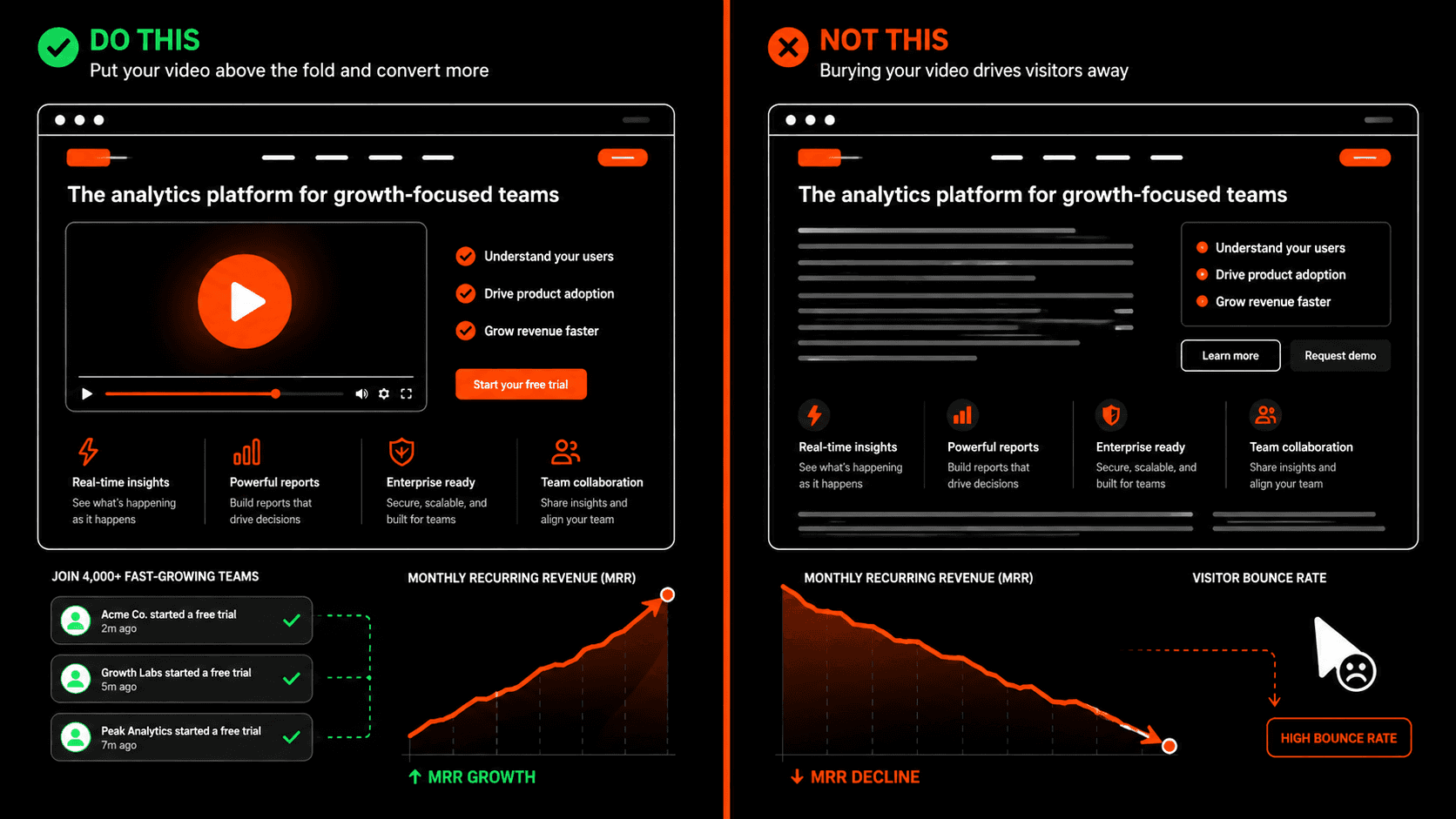

Let me tell you the number that stopped me mid-conversation with a founder last month. He'd spent $4,000 on a homepage explainer video six months prior. Traffic was healthy. Paid campaigns were running. And his conversion rate had barely moved. When I asked him what his video play rate was, he went quiet. He'd never checked.
According to Wistia's 2026 State of Video Report the most comprehensive video marketing dataset available, drawn from over 13 million videos and 79 million hours of viewing data homepage videos achieve a 24% play rate on average. That means 76 out of every 100 visitors who land on a page with a video never press play. For SaaS founders without a homepage video at all, that number is 100%. Every single visitor leaves without ever understanding why your product exists.
This isn't a traffic problem. It's a conversion engineering problem. And it's costing you MRR every month it goes unfixed.
Why Does Nobody Hit Play on Your Homepage Video?

The honest answer is almost never "our product is boring." It's almost always one of three things: the video is buried below the fold where visitors never reach it, the thumbnail gives no reason to click, or the first three seconds of the video fail to create enough tension to keep watching.
Wistia's 2026 data is clear that homepage videos outperform every other page type for play rate — but a 24% average means even well-placed homepage videos are losing three quarters of their potential audience before a single second of content plays. When a generalist studio delivers your video, they optimise for how it looks in their portfolio. They don't optimise for thumbnail click-through, above-the-fold placement, or the specific six-word opening that makes a stressed SaaS founder stop scrolling.
The 76% scroll-past rate isn't a viewer attention problem it's a video placement and hook problem that most studios never consider because they're paid to produce, not to convert.
The Explainerz Fix: Every SaaS explainer video we build includes placement strategy, thumbnail design brief, and an opening hook engineered to pull the exact ICP who landed on your page into the first ten seconds.
What Does the Play Rate Gap Cost in Real MRR?

Run this through your own numbers. Say your SaaS homepage gets 4,000 visitors a month. At a 24% play rate, 960 visitors watch your video. At the industry median conversion rate of 2–5% for B2B SaaS (Varos 2026), those 960 engaged viewers who have already pre-qualified themselves by choosing to watch convert at the higher end of that range because they arrive at your trial signup already educated. The 3,040 who scrolled past convert at the lower end, or not at all.
Now consider what Unbounce's landing page research confirms: pages with embedded video convert up to 80% higher than text-only equivalents. That gap between your current play rate and a video optimised to earn more clicks is where your MRR is hiding. At $99 ARPU on 4,000 monthly visitors, moving from a 24% to a 45% play rate achievable with above-the-fold placement, a strong thumbnail, and a hook that names the pain in the first sentence adds meaningful monthly revenue from the exact same traffic you're already paying for.
The MRR gap created by a low play rate isn't a future problem it's a present one, and it gets more expensive every month your paid acquisition costs stay flat while your conversion rate doesn't move.
The Explainerz Fix: Our SaaS demo videos are scripted around the moment a visitor decides whether to stay or bounce because that decision happens in the first five seconds, not the first minute.
Why Does Your Existing Video Have a Low Play Rate?
If you've already invested in a homepage video and your play rate is below 20%, the culprit is almost always one of four things. First: placement. A video that lives below a wall of headlines, subheadlines, and feature bullets is not a homepage video it's a footnote. Wistia's own research confirms that homepage placement is where videos earn their highest play rates across the entire site. If your video isn't the first thing a visitor's eye lands on above the fold, you've already lost most of your potential audience.
Second: thumbnail design. The thumbnail is your video's CTA. A blurry frame-grab of your animation is not a CTA. A thumbnail that shows a founder facing the camera with a caption like "60 seconds — see exactly what we do" is.
Third: autoplay decisions. Autoplay with sound drives visitors away. Autoplay muted with captions can lift play rates for some audiences. Wistia's 2026 data suggests the right call depends on your traffic source and page intent there's no universal answer, but there is a testable one.
Fourth: the first three seconds. Wyzowl's 2026 State of Video Marketing Report finds that 96% of people have watched an explainer video to learn about a product meaning intent is not the problem. The problem is that most explainer videos open with a brand logo, a generic tagline, or a piece of abstract animation that says nothing specific to the viewer. The first sentence of your video script is the hook. If it doesn't name the exact pain your ICP lives with, they stop watching.
A low play rate is a diagnostic, not a verdictit tells you exactly which of four fixable problems is killing your conversion before the video has a chance to work.
The Explainerz Fix: Explainerz has delivered 150+ SaaS explainer videos for companies including Kodecloud, Sencha, and McGraw Hill built by people who run play rate analysis as part of every engagement. See the work at explainerz.com/work.
What Does a High-Converting SaaS Homepage Video Actually Contain?
Wyzowl's 2026 data shows that 85% of people say video has convinced them to buy a product or service. But that stat describes what video can do not what every video does. The delta between a video that converts and one that doesn't comes down to structure.
A homepage video that moves the conversion needle opens with the buyer's pain in the first sentence not the product name, not the company story. It shows the product UI in action within the first twenty seconds, because B2B SaaS buyers in 2026 have learned to distrust abstract animation and want to see the actual dashboard performing the actual task. It delivers one proof point a metric, a client outcome, a before-and-after that makes the promise feel real. And it ends with a single, specific, low-friction CTA with zero ambiguity about what happens next.
Aimers' 2026 SaaS CRO research confirms the highest-converting homepage video format right now is a 45–60 second authentic product or founder-led video. Not polished to the point of feeling corporate. Not so raw it looks unplanned. Direct, specific, and built around the buyer's decision not the founder's pride in what they've built.
The difference between a video that earns a 24% play rate and one that earns 45% is not production budget it's how well the first six words match the exact thought the visitor was already having when they landed on the page.
The Explainerz Fix: Every Explainerz script opens with the buyer's pain, not the product's features. Our scripting process starts with your ICP, not your feature list. Start the conversation.
The AI Video Shortcut That's Quietly Killing Play Rates
In 2026, AI video tools have made it cheaper than ever to produce something that looks like a homepage video. The temptation is understandable. But Aimers' SaaS CRO research notes that 91% of businesses now use video as a marketing tool saturation is real, and the competitive advantage from simply having a video is gone. What remains is the advantage of having a video that viewers trust enough to watch.
Wyzowl's 2026 data shows that 83% of video marketers say video has directly increased their sales but that's among marketers whose videos actually work. AI-generated avatars reading templated scripts produce content that B2B buyers have learned to recognise and dismiss. The cost saving at the production stage becomes a conversion penalty at the homepage stage, and a conversion penalty at the homepage stage becomes a CAC problem that no amount of paid acquisition can solve.
AI video tools are a production efficiency play for volume content — not a replacement for the strategic scripting and SaaS-specific storytelling that turns a homepage visitor into a trial signup.
The Explainerz Fix: No AI avatars. No generic templates. Explainerz builds human-scripted, SaaS-specific explainer videos at $2,500 one-time —cripting, storyboard, animation, voiceover, 3 revisions, 2–3 week delivery.
Where Should You Place the Video and What Should Drive the Click?

Wistia's 2026 State of Video confirms homepage videos achieve the highest play rates of any page type on a company's website. But that benchmark assumes the video is findable. The placement decision above the fold, centered, with a strong thumbnail is not aesthetic. It is the single biggest lever on your play rate outside of the script itself.
We've covered the full mechanics of why video placement changes buyer psychology in our post on how SaaS demo videos double your demo booking rate. The same principle applies here: a visitor who arrives at your trial signup page having already watched your homepage video is a fundamentally different prospect from one who arrived via a text-only page. The video does the selling. The signup form just captures the decision that's already been made.
Think of the thumbnail as your video's above-the-fold headline. It earns the click that earns the view that earns the trial. Most SaaS founders spend weeks on their headline copy and five minutes on their video thumbnail. That's the wrong allocation.
Placement and thumbnail design are not post-production afterthoughts they are the first conversion event in your video funnel, and they determine whether everything else you spent on production gets seen.
The Explainerz Fix: Explainerz advises on placement, thumbnail design, and autoplay strategy as part of every engagement because a great video buried below the fold converts no better than no video at all.
How Long Will It Take to Recover the Investment?
Wyzowl's 2026 State of Video Marketing Report shows that 40% of teams plan to increase video spend this year down from 57% in 2023 meaning most SaaS founders are under-investing in video at the exact moment when video's competitive advantage has shifted from adoption to quality. The founders who move now are buying a conversion advantage that their underspending competitors are voluntarily leaving on the table.
An Explainerz homepage video costs $2,500 one-time. At the verified Unbounce benchmark of up to 80% conversion lift for video pages versus text-only, the MRR recovered from existing traffic pays for that investment within the first month for the vast majority of SaaS companies operating above a $50 ARPU. Clients including Kodecloud and Sencha have reported demo booking rates doubling after deploying Explainerz videos a result that maps directly to the documented play rate and conversion data.
The question isn't whether a SaaS homepage video is worth $2,500. The question is how much MRR your current play rate has already cost you since the last time you addressed it.
The Explainerz Fix: Ready to close the gap? One video. 2–3 week delivery. Three revisions included. Start here.
The Decision You're Actually Making
Every day your SaaS homepage has a video nobody clicks play on or no video at all you are making a choice. You're deciding that 76% of your visitors should have to figure out your product from text alone. You're deciding that the conversion gap between where you are and where you could be is acceptable. You're deciding that your CAC is someone else's problem.
I'm not interested in selling you a video for the sake of having one. I'm interested in founders who are ready to look at their play rate, run the MRR math, and fix it with something built by people who understand SaaS conversion not animation.
If that's you, let's talk. Fill out the form at explainerz.com/contact or drop us a line directly at Sales@explainerz.com. No pitch deck. No retainer. Just a direct conversation about your numbers and the video that closes the gap.


