Video Marketing
Product & Demo Videos
Explainer Videos
Conversion & SaaS Growth
Dixie

Flat-Rate vs. Per-Minute Explainer Video Pricing: Which One Actually Protects Your Budget?
A SaaS founder we came across recently went looking for a 90-second explainer video and got quoted $3,200. By the time the studio factored in the extra 30 seconds the script actually needed, the number was $3,800 a jump of roughly 19% before a single revision had even been requested. MotionCue documented that exact quote from Yum Yum Videos in a studio comparison piece, and it's not an outlier. It's how the most common pricing model in this industry behaves by design.
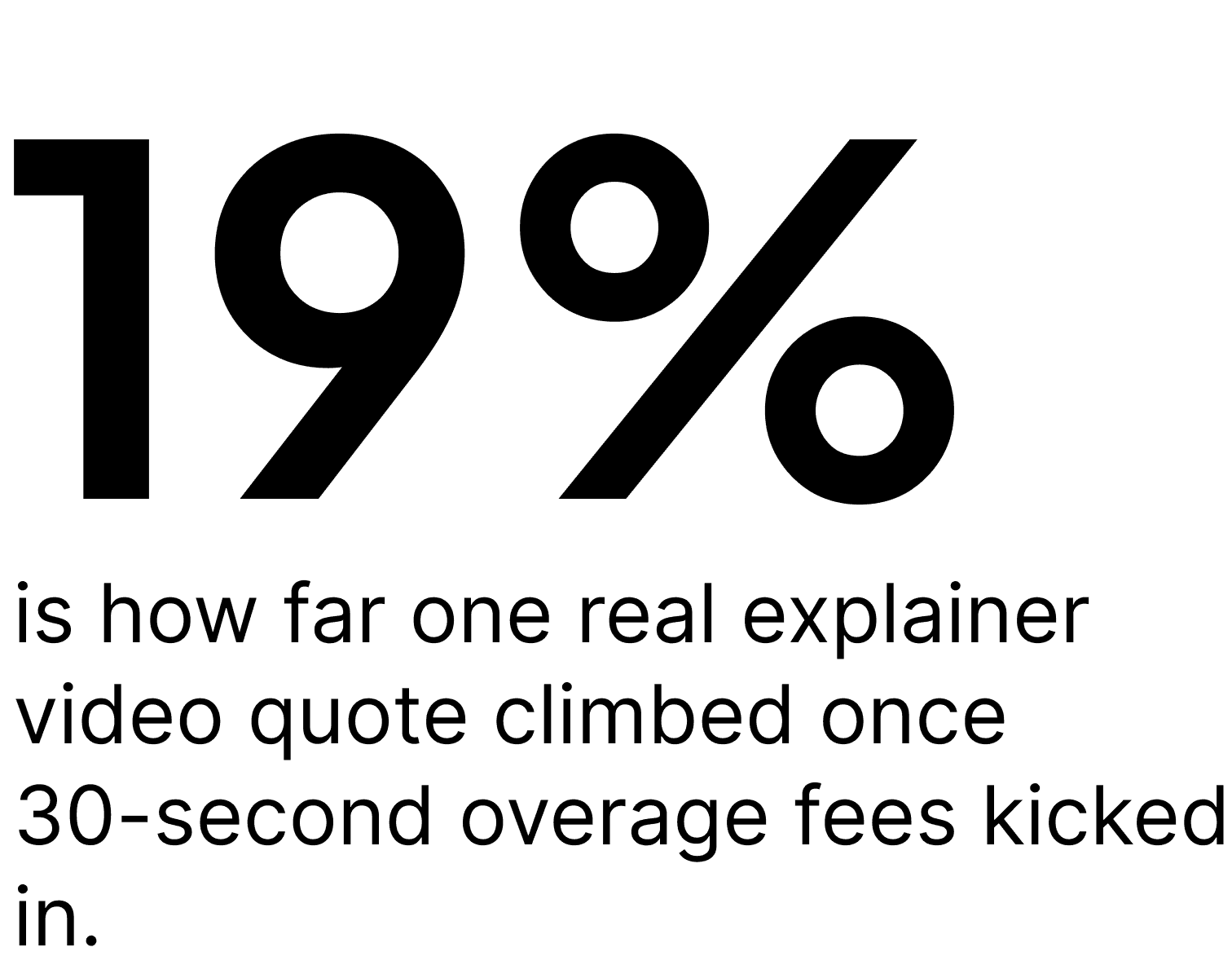
That model is per-minute (or per-second) pricing, and it's the default at most of the studios a SaaS founder will find in a first round of research. Wyzowl's survey of 242 explainer video companies put the mean price at $10,983, with quotes ranging from $600 all the way to $250,000. Wide ranges like that usually mean one thing: the number you're shown first and the number you eventually pay are two different conversations, and the gap between them depends on a variable nobody mentions on the pricing page — how long your script ends up being once the actual product gets explained.
This post isn't another breakdown of what an explainer video should cost, we've already mapped that by funnel stage in our guide to SaaS explainer video cost tiers. This one is about the pricing model underneath the number: what per-minute pricing actually does to a budget once production starts, what a flat-rate quote does differently, and how to tell which one you're actually being offered before you sign anything.
Why does a $3,200 quote become a $3,800 invoice?
Per-minute and per-second pricing isn't hidden it's usually right there in the fine print. Breadnbeyond's own packages page states it plainly: each package covers one minute of animated video, with an additional charge for every 10 seconds beyond that. Yum Yum Videos' real quote, as reported by MotionCue, worked the same way: $3,200 for the first 60 seconds, then $600 for every additional 30 seconds. Neither studio is doing anything deceptive. The problem is structural. The headline number was only ever a starting point, and SaaS scripts rarely land exactly at 60 seconds on the first draft.
A per-minute quote is a starting point, not a final price and SaaS scripts rarely land exactly where the first draft predicted.
The Explainerz Fix: We quote one number for the finished script length, not the first 60 seconds, which is also how our SaaS explainer video service is structured from the first conversation.
What does "per minute" actually mean once the script runs long?
SaaS explainer scripts are rarely static. Product teams add a feature mid-project, leadership asks for one more scene to cover a use case, or the voiceover needs a re-record after a name change. None of that is unusual — it's just how SaaS moves, especially for a product that's still shipping new functionality while the marketing video is in production. Under a per-minute model, every one of those normal adjustments reopens the price, because the studio's entire scope was built around a runtime estimate rather than the actual finished script. Demo Duck's posted budget guidance illustrates the other version of this same unpredictability: a blanket range of $1,500 to $50,000, with a stated recommendation to budget $15,000–$25,000 for a higher-end project guidance that pushes a buyer toward spending more without ever pinning down a fixed scope, which leaves just as much room for the number to drift as a per-second add-on does.
Per-minute pricing punishes the exact behavior scripts that evolve — that's normal for a SaaS team mid-launch.
The Explainerz Fix: A flat quote means a fourth scene or a script revision doesn't trigger a new invoice line, which is the same reason our SaaS demo video projects are priced as one number up front.
Is a low headline number ever a red flag?
Sometimes. Wyzowl's research found that some studios advertise a lower opening price, then add separate charges for voiceover and for each round of revisions once the contract stage arrives. None of this shows up on the page that got the founder to reach out in the first place. It's not necessarily bad faith voiceover talent and extra revision rounds are real costs but it does mean the number that won the founder's attention isn't the number that will appear on the final invoice.
The number that wins your attention and the number on your final invoice are often two different figures ask which one you're actually comparing.
The Explainerz Fix: Our $2,500 flat package already includes voiceover and three revision rounds, so there's no second invoice waiting once the storyboard is approved see the full breakdown on our app explainer video page.
How does a flat-rate quote protect the budget?
A flat-rate quote works the opposite way: the number agreed at signing is the number on the delivery invoice, regardless of how the script shifts during production. That's not because flat-rate studios are cheaper by definition Demo Duck's $20,000–$25,000 stated range for a custom 2D animated video is a flat number too, just a much larger one. It's because a flat quote forces the studio to commit to a scope before the work starts, instead of leaving room for the price to move once it does.
A flat quote forces the studio to commit to a scope before work starts, instead of leaving the price free to move once it does.
The Explainerz Fix: Every Animated Explainer project we deliver is the same: one flat $2,500 number covering script, storyboard, animation, voiceover, and three revisions you can see examples of finished projects in our portfolio.

What should you actually ask before signing any quote?
The fastest way to tell the two pricing models apart is to ask whether the quoted number is the total price for the finished script, or just the price for the first 60 seconds with everything else still to be determined. A studio working from a flat-rate model can usually answer that in one sentence, because the full scope was already priced in. The same goes for voiceover ask directly whether it's included in the number you're looking at, or billed as a separate line once the script is locked. Revisions deserve the same direct question: are they bundled into the price you agreed to, or charged individually as they come up. And worth asking plainly: is there a cap on the final number at all, or does it scale with however many seconds the finished video ends up running.
The studios with nothing to hide can answer all four questions in one sentence each the ones that can't are telling you something too.
The Explainerz Fix: Ask us any of these four questions and the answer is the same every time book a quick call through our contact page and we'll walk through the full scope before you sign anything.
Does a cheaper per-minute rate ever make sense?
To be fair to the model: per-minute pricing isn't automatically a worse deal, and it can work reasonably well for short, tightly scoped pieces where the length is locked before the studio ever opens a script document — a 15-second social cutdown, for instance, where there's no realistic scenario in which the runtime grows. The risk shows up specifically in SaaS explainer projects, where scripts evolve as the product does, features get added mid-review, and a "final" length is rarely final until the last approval. That's the exact scenario where a model priced by the second turns every normal revision into a new number.
Per-minute pricing isn't a bad model everywhere it's a bad model anywhere the script is likely to change, which describes most SaaS explainer projects.
The Explainerz Fix: If your project genuinely has a fixed, unchanging runtime, a per-minute quote might be fine if it doesn't, our flat-rate SaaS explainer video model is built for exactly that uncertainty.
The decision you're actually making
Choosing between a flat-rate and a per-minute quote isn't really a decision about price. Both models can land at similar totals for the same finished video, especially once revisions and voiceover are factored in on the per-minute side. What you're actually deciding is who absorbs the risk when the script changes and in SaaS, the script almost always changes at least once between the kickoff call and final delivery. A per-minute model puts that risk on you, line item by line item, invoiced as it happens. A flat-rate model puts it on the studio, where it belongs, because the studio is the one that committed to the scope before production started rather than after.
If you're currently holding a quote and aren't sure which model you're looking at, the fastest way to find out is to ask the four questions above and see how directly they get answered. A studio with a genuinely flat model won't need to check with anyone before answering; a studio working per-minute usually will. Or skip the back-and-forth entirely: reach out through explainerz.com/contact or email Sales@explainerz.com, and we'll tell you exactly what's included in your number before you sign anything.


