Video Marketing
Product & Demo Videos
Explainer Videos
Conversion & SaaS Growth
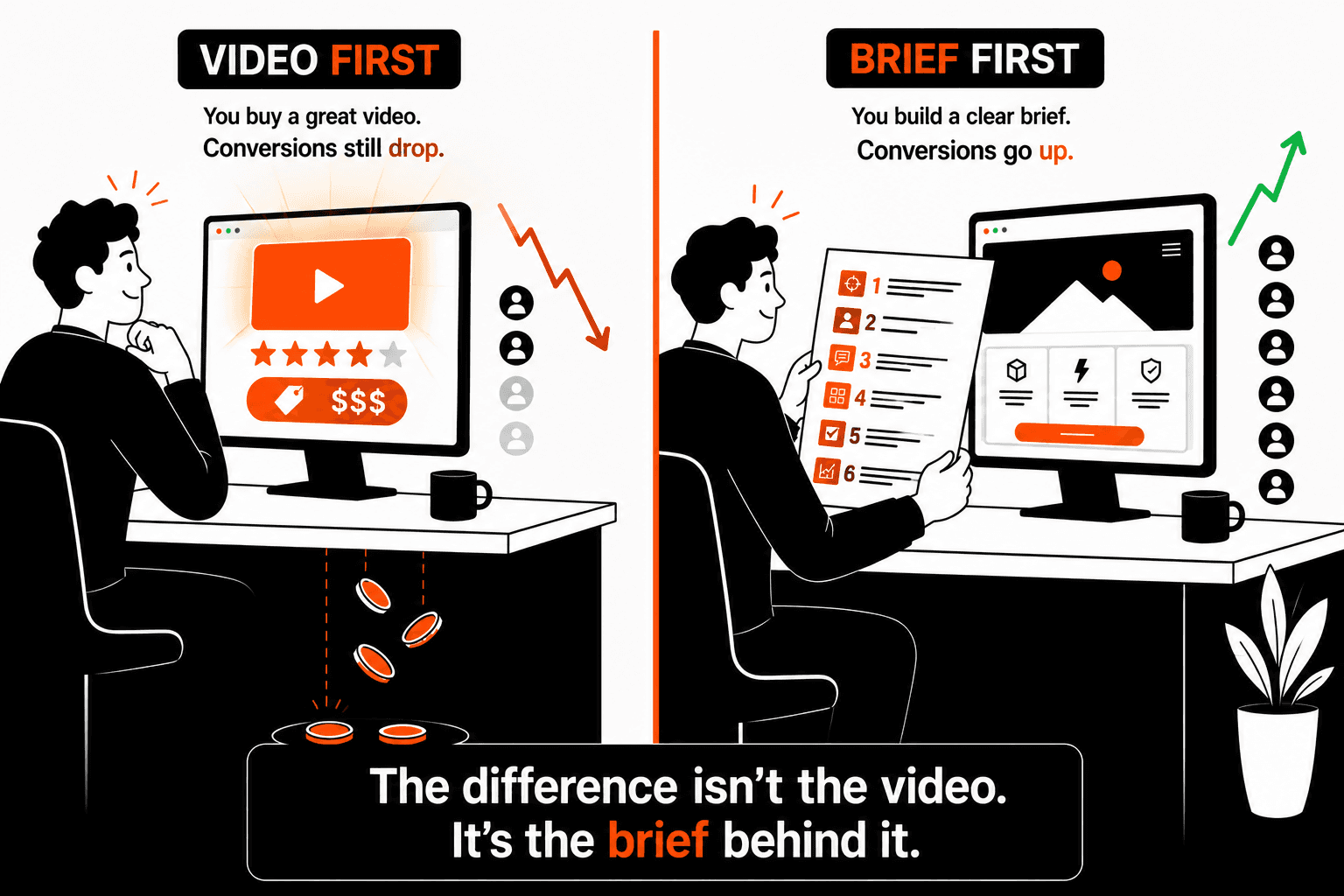

A founder reached out to me three months ago. He'd spent $9,000 on an explainer video from a well-regarded agency. The animation was stunning. The voiceover was warm and professional. The music built perfectly. It went live on his homepage on a Tuesday. By the following Monday, he was back in my inbox. Watch rate: 14%. Click-through: 0.3%. Trial signups: unchanged.
The video wasn't bad. It was briefed wrong. And that distinction is the most expensive misunderstanding in SaaS marketing right now.
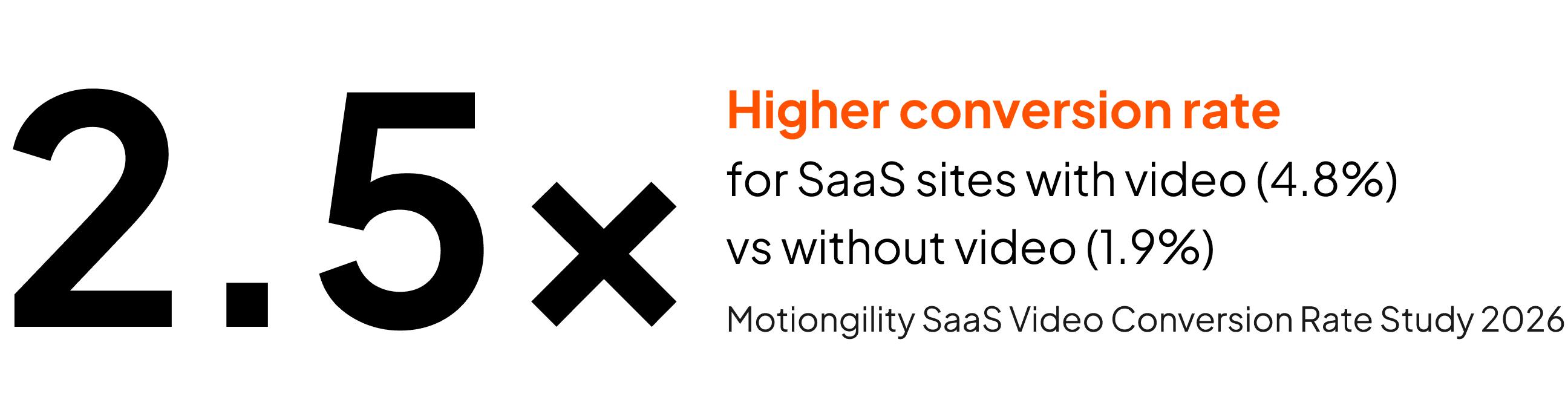
SaaS websites with product videos convert at 4.8% on average. Sites without them convert at 1.9%. That's nearly a 2.5× difference a number that should make every SaaS founder stop what they're doing and pay attention. But that 4.8% is not what you get from any video. It's what you get from a video built around the right brief. The founder I described above didn't get 4.8%. He got less than what he had before he spent $9,000.
What Does "Briefed Wrong" Actually Mean?
Most SaaS founders approach a video brief the way they'd approach a design brief: they describe what they want the output to look like. They specify the tone, the animation style, the length, the music feel, the colour palette. They write a detailed document about aesthetic intent. And then they hand it to a studio that executes exactly what they asked for a beautiful video that tells nobody anything specific about why they should stop what they're doing and start a free trial.
A conversion-engineered brief looks completely different. It starts not with how the video should feel but with who is watching it, what they're worried about right now, and what single action they need to take by the time the video ends. It treats the video as a direct-response asset the same way a high-converting landing page is a direct-response asset not as a brand expression.
The most common brief failure mode I see is founders writing about their product instead of their buyer. "We want to show how our platform integrates with existing workflows and reduces operational complexity." That's a feature list dressed up as a brief. The buyer sitting on your homepage at 11pm doesn't care about operational complexity. They care about the specific, painful thing that's happening to their business right now that your product fixes.
The brief failure is not a production problem it's a perspective problem. Most SaaS founders brief from inside the product looking out, when the entire video needs to be built from outside the buyer's problem looking in.
The Explainerz Fix: Every SaaS explainer video we build starts with a conversion brief not a creative brief. Our process begins with your ICP, their exact pain, and the single action the video needs to produce. Aesthetic decisions come last.
Why Does a Wrong Brief Produce a Video That Looks Right?
This is the cruel mechanics of the problem. A generalist studio executing a wrong brief produces exactly what the brief specifies and because the founder wrote the brief, it feels right to them. Every revision is judged against the brief, not against conversion intent. When the final video lands and the founder watches it, it matches what they asked for. They approve it. They publish it. And then it converts nobody, because the brief was built around what the founder wanted to say rather than what the buyer needed to hear.
The 2026 SaaS video landscape has made this worse. AI tools have driven production costs down sharply, which means more SaaS founders than ever are publishing video and more are publishing video briefed wrong. TheBullseye's 2026 SaaS Video Marketing Playbook, drawn from 20+ SaaS video projects, makes this explicit: AI tools have made production cheaper than ever, so most teams are publishing more video than ever and seeing less return on it. The problem is not production quality. It is strategy.
A wrongly briefed video is more expensive than no video at all. No video leaves the conversion gap open and visible. A wrongly briefed video closes the gap in the founder's mind while leaving it fully open in the market meaning they stop looking for the fix because they believe they've already applied it.
A beautiful video built to the wrong brief is the most expensive outcome available to a SaaS founder because it costs production budget plus every month of lost conversion while the founder believes the problem is solved.
The Explainerz Fix: Explainerz has delivered 150+ SaaS explainer videos for companies including Kodecloud, Sencha, and McGraw Hill. Our brief framework is built to prevent the exact failure mode described above. See what a conversion-engineered video looks like at explainerz.com/work.
What Does a Conversion-Engineered Brief Actually Contain?
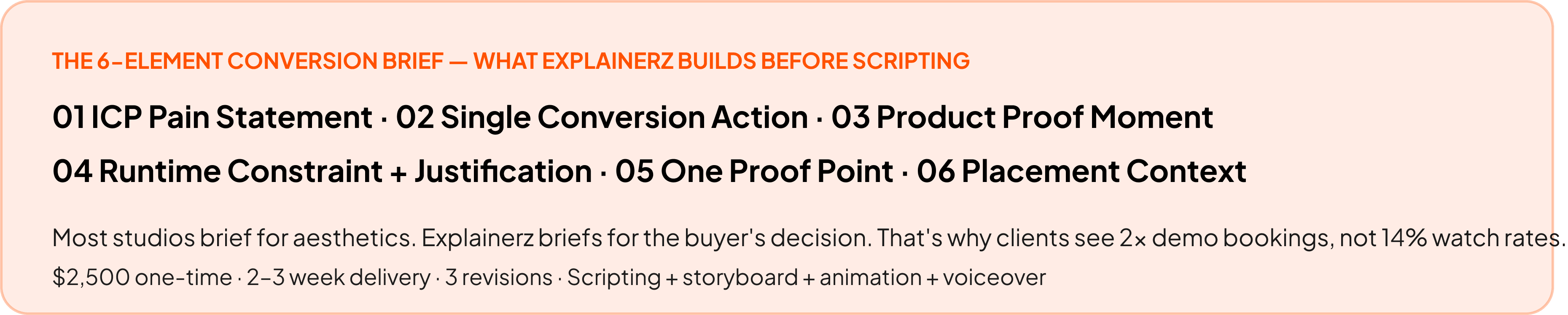
A brief that produces a converting SaaS explainer video contains six specific elements and the order matters as much as the content.
The first element is the ICP pain statement: one sentence, written in the buyer's exact language, that describes the specific problem they have right now. Not the category of problem. Not the general pain point. The exact sentence your best customer said in a sales call before they bought. Research from WhatAStory's 2026 SaaS product launch analysis confirms that videos leading with a relatable frustration convert 22% better than those starting with a company logo. That 22% lift starts in the brief, not in the edit.
The second element is the single conversion action: one specific thing the viewer should do by the time the video ends. Not "learn more about us." Not "visit our pricing page." One action start a free trial, book a demo, sign up now and the brief must specify why that action is low-friction for this buyer at this stage.
The third element is the product proof moment: the specific feature or workflow that collapses the gap between the pain you opened with and the solution you're offering. This is the moment the video shows the product doing the thing, not talking about the thing. 63% of consumers prefer short video when learning about a product but what they're actually doing is looking for proof that the product does what it claims.
The fourth element is the runtime constraint with justification. Not "keep it under two minutes." The brief should specify 45–90 seconds and explain which stage of the buyer journey this video serves. A homepage video has different runtime economics than a retargeting video.
The fifth element is the one proof point: a single metric, client outcome, or before-and-after that makes the promise feel real. Not three testimonials. Not a case study summary. One data point that lands in five seconds.
The sixth and final element is the placement context: where the video will live, what the viewer has already seen before they reach it, and what the page CTA says so the video's CTA creates continuity rather than conflict.
A conversion-engineered brief is a document about the buyer's decision not the product's features. Every element in it serves the moment the viewer chooses to act or bounce.
The Explainerz Fix: Our briefing process is built around all six elements above. We run a structured ICP session with every client before a single frame is storyboarded because a correct brief makes everything downstream faster, cheaper, and more effective. Start the conversation.
The Five Most Common Brief Mistakes SaaS Founders Make
The first is leading with the product name. Your video's opening line should never be your product name. The viewer already knows they're on your website. What they don't know yet is whether you understand their problem well enough to deserve their attention. Open with the pain.
The second is listing features instead of outcomes. "Our platform offers real-time collaboration, automated reporting, and API integrations" is a spec sheet. "Your team stops losing deals to slow internal approvals" is a brief. The brief must describe outcomes, not capabilities.
The third is briefing for the wrong audience. Founders often brief from their own perspective the person who built the product and knows every nuance of it. The viewer has zero context. The brief must be written from zero-context, first-encounter perspective.
The fourth is specifying the wrong runtime. Longer is not more comprehensive it's more abandoned. We covered the full play rate mechanics of homepage video runtimes in our post on why 76% of SaaS homepage visitors scroll past your video. The brief should lock runtime to the placement and stage.
The fifth is forgetting to brief the CTA. Most video briefs end with "and then we'll include a call to action at the end." That's not a brief. That's an afterthought. The CTA is the entire point of the video. Brief it with the same specificity you'd use for a paid ad headline.
Brief mistakes are invisible until the video is live at which point they're irreversible without restarting production. Every one of the five above is preventable before a single script line is written.
The Explainerz Fix: Our SaaS demo videos are briefed with the same six-element framework adapted for the demo booking context, where the conversion action is a scheduled call, not a trial signup.
How Explainerz Fixes the Brief Before We Touch the Script
Our process starts with a structured ICP session a 45-minute conversation designed to extract the six brief elements above from the founder before we write a single word of script. We ask the questions most studios skip: What does your best customer say in the first sales call? What objection kills the most deals? What's the one thing every trial user who converts understands that every trial user who churns doesn't?
The answers to those questions are the brief. The script is just the brief turned into spoken sentences. The animation is just the script turned into visuals. If the brief is wrong, everything downstream is wrong and no amount of production quality can fix it in post.
This is why Explainerz clients including Kodecloud and Sencha have seen demo booking rates double after deploying our videos. Not because the animation was prettier than what they had before. Because the brief was built around the buyer's decision, not the founder's pride in what they'd built.
The investment is $2,500 one-time. The brief session is included. Scripting, storyboard, animation, voiceover, and three revisions are included. Delivery in 2–3 weeks.
The right brief costs nothing extra and changes everything about what the video produces which is why it's the first thing we do and the last thing most studios think about.
The Explainerz Fix: The brief is where the 4.8% conversion rate is either won or lost. We build ours around your buyer's decision, not your product's feature set. Start here.
What Should You Do If Your Current Video Is Briefed Wrong?
Don't recut it. Don't add a new voiceover track. Don't change the thumbnail and hope for different results. Start with the brief. Go back to the six elements above and check your current video against each one honestly. If the opening line is your product name or a tagline it's briefed wrong. If the CTA is "learn more" it's briefed wrong. If the video shows features before it names a pain it's briefed wrong.
Once you know which element failed, you know what the new brief needs to fix. And a new brief produces a new video one built to convert, not to look impressive in an agency's portfolio.
The Decision You're Actually Making
Every SaaS founder who publishes an explainer video makes a choice about what the brief optimises for. Optimise for aesthetic — you get a video your team loves and your buyers ignore. Optimise for conversion — you get a video that closes the gap between your current 1.9% and the 4.8% that SaaS companies with correctly briefed videos are hitting.
I'm not interested in making videos that look good. I'm interested in founders who are ready to brief correctly and let the conversion data speak.
If that's you, let's talk. Fill out the form at explainerz.com/contact or drop us a line at Sales@explainerz.com. We'll run through the six-element brief framework together and tell you exactly what your current video is missing — before we write a single word of script.


