Video Marketing
Product & Demo Videos
Explainer Videos
Conversion & SaaS Growth
Dixie

Here's the "text twin" framework that keeps your video budget from going invisible to AI search.
You paid $1,800 for a homepage explainer. It's crisp, it's on-brand, and it converts the humans who land on your page and press play. Meanwhile, a growing share of the people evaluating your product never press play at all they ask ChatGPT or Perplexity to compare you against two competitors, and your video, the thing you spent the most on to explain your product clearly, contributes nothing to that answer.
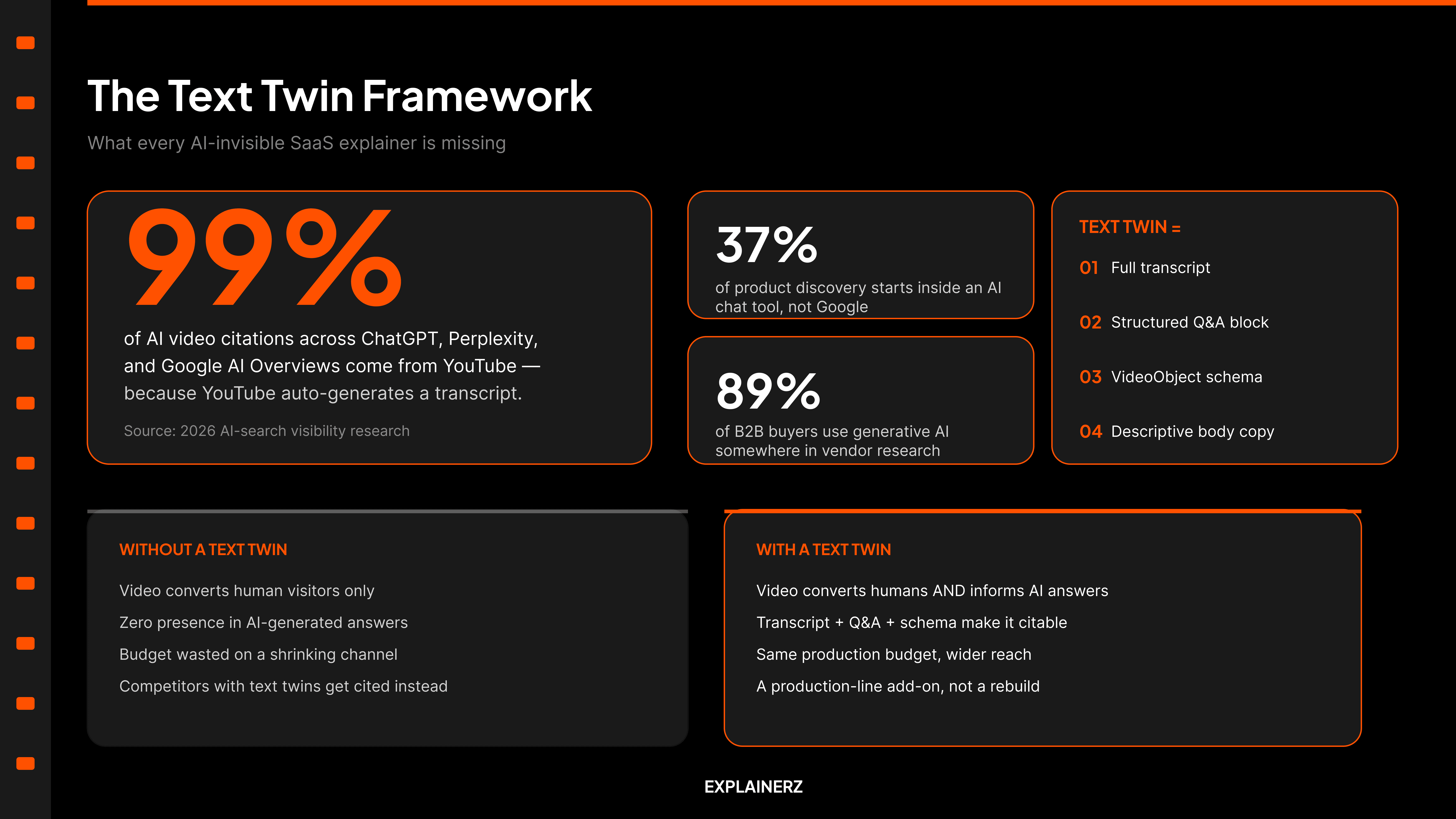
That's not a traffic problem. It's a comprehension problem wearing a traffic problem's clothes. 37% of product discovery queries now start inside an AI chat tool instead of Google, and 89% of B2B buyers use generative AI somewhere in vendor research. Your video was built to be watched. Increasingly, it needs to be read by a machine that will never watch it.
The fix isn't a better video. It's giving the video you already have a machine-readable counterpart. Founders who skip this step aren't losing to a competitor with a better explainer. They're losing to a competitor whose explainer has a text twin and theirs doesn't.
Why Is Your Explainer Video Invisible to ChatGPT and Perplexity?
Large language models don't have eyes. When Perplexity or ChatGPT cites a source, it's pulling from text it can parse a transcript, a caption, the copy surrounding an embed, structured data in the page's markup. YouTube dominates AI video citations for exactly this reason: not because YouTube videos are better, but because YouTube auto-generates a transcript for every upload, and that transcript is exactly the kind of text an answer engine can ingest.
A self-hosted explainer sitting inside a Framer or Webflow page, with no transcript and no surrounding copy beyond a headline, gives the model nothing to read. It's not that the AI ranked your video and found it lacking. It never saw it as a candidate in the first place.
In short: AI answer engines cite text, not footage so a video with no readable layer around it is functionally absent from AI-driven discovery, no matter how good the video itself is.
The Explainerz Fix: Every SaaS explainer video we ship now comes with a transcript and structured summary as standard delivery, not a paid add-on — because a video without a text layer is half a deliverable.
What Exactly Is a "Text Twin"?
A text twin is the written counterpart to your video, published on the same page, built specifically so an AI tool has something to read instead of something to watch. It has three parts: a full transcript of the video's audio, a structured Q&A summary that mirrors the questions a buyer would actually type into ChatGPT, and schema markup that tells search engines and AI crawlers what the video is and what it covers.
None of this replaces the video. A prospect who watches your 90-second demo still gets more than a prospect who reads a summary of it. But the AI tool doing research on your prospect's behalf will only ever encounter the text twin so if it isn't there, your video's entire persuasive effort happens exclusively for the small and shrinking share of buyers who never touch an AI tool during evaluation.
In short: a text twin is the transcript, Q&A summary, and structured markup that makes a video legible to a system that can't watch it.
How Do AI Answer Engines Decide What to Cite?
AI visibility still runs through the same infrastructure as Google. Most answer engines are indexing the open web, weighting pages that are well-structured, directly answer a specific question, and carry credible on-page signals then citing the source when a user's question matches. A page that buries its video behind a generic headline and no supporting copy has almost nothing for that matching process to grab onto.
This is why the buyers researching your category inside ChatGPT aren't finding you even when your video answers their exact question. The answer exists. It's just trapped in a format the retrieval layer can't parse. Pairing every cornerstone video with narrative text, a structured table, or a downloadable asset isn't a nice-to-have anymore it's what determines whether that content can even enter the citation pool.
In short: if a buyer's question is best answered by a video but the page has no text version of that answer, the citation goes to whichever competitor made their answer legible instead.
The Explainerz Fix: When we build a SaaS product demo video, we write the on-page copy around it to directly answer the three or four questions that video is actually solving not just describe what the video contains.
What Should Actually Go Into a Text Twin?
Keep it to four components, shipped on the same page as the embed, not linked off to a separate resource:
A full transcript, timestamped if your CMS supports it, placed directly beneath the player. A structured Q&A block three to five questions phrased the way a buyer would actually ask them, each with a two-to-three sentence answer pulled straight from the video's content. VideoObject schema in the page's JSON-LD, so crawlers get a structured signal even before they parse the surrounding copy. And descriptive body copy around the embed itself not "Watch our demo," but a paragraph that states what the product does and who it's for, in plain language.
This is a production-line add-on, not a rebuild. You're not re-scripting the video or re-recording anything. You're writing down what's already in it, in a format a machine can read.
In short: a transcript, a Q&A block, VideoObject schema, and descriptive surrounding copy all on the same page as the video cover what most AI-invisible explainers are missing.
Does VideoObject Schema Really Matter, or Is It Technical Theater?
It matters, but not on its own. Schema is a structured hint, not a substitute for readable content — it tells a crawler "this is a video, here's its duration, here's its thumbnail, here's a text description," but if that description field is thin, the schema just formalizes an empty answer. The transcript and the Q&A block do the heavy lifting; VideoObject schema makes sure the crawler finds them faster and trusts the page's structure while it's there.
Founders who add schema and skip the transcript are optimizing the packaging on a box with nothing inside. Founders who write a transcript and skip the schema are leaving an easy, low-cost signal on the table. You need both, and the schema takes a competent developer under an hour to implement once the text twin exists.
In short: schema accelerates discovery of a text twin that already exists it doesn't create AI visibility by itself.
The Explainerz Fix: Our portfolio shows the pattern across client pages every embed sits inside a page built to be read first and watched second, which is the opposite of how most agencies hand off a final video file.
Is This Just SEO Busywork, or a Real Production Line Change?
It's a real change, but a small one, and that's the point. This isn't a rebuild of your content strategy it's an addition to how a video gets delivered. If your studio hands you an MP4 and nothing else, the text twin work falls entirely on you or gets skipped. If the studio treats the transcript, the Q&A block, and the surrounding copy as part of the deliverable, it ships with the video instead of trailing it by six months.
his one is about what happens after the script is good and the video is done: whether anything built around it lets AI find it at all. They're different failure points in the same pipeline, and most founders have neither one solved.
In short: the text twin isn't a separate SEO project it's a missing step in video delivery that most studios still don't include.
The Decision You're Actually Making
This was never really a question about transcripts. It's a question about whether the video you already paid for gets to compete in every channel your buyers actually use, or only the ones that existed five years ago. A $1,800 explainer with a text twin does more work than a $5,000 explainer with none, because the second one is invisible to a channel that's already carrying more than a third of product discovery traffic.
You don't need a new video. You need the one you have to stop disappearing the moment a buyer asks an AI tool a question instead of typing it into Google.
Book a free strategy call and we'll audit whether your current explainer has a text twin or send us a note directly at Sales@explainerz.com and we'll walk you through what's missing.
#AISearchOptimization
#AnswerEngineOptimization
#ExplainerVideo
#ProductMarketing